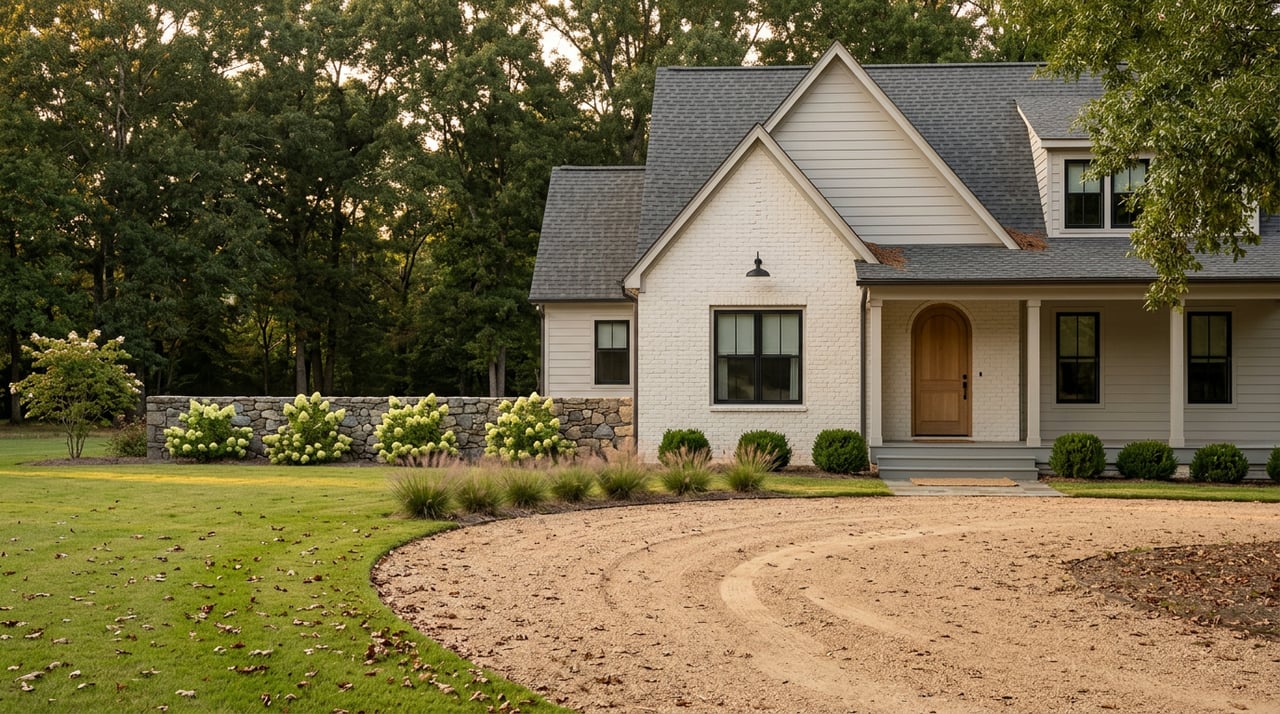
The listing portals will show you a number. In May 2026, that number was roughly $475,000, down about two percent from a year earlier, at a median list price of around $227 per square foot. Then you drive out NC 27, see a stone-and-Hardie custom on nearly three acres priced against a 1980s ranch on a half acre a mile away, and the number stops explaining anything.
Iron Station is a mid-funnel market that behaves like a bundle. Buyers who treat it as a single price point tend to overpay for the wrong thing or walk away from the right one. The friction that decides whether a purchase actually closes on time rarely appears in a listing description. It sits inside a county office in Lincolnton.
The Permit Desk That Sets Your Closing Calendar
Iron Station is an unincorporated community, which means almost every home here runs on a private well and a private septic system rather than municipal utilities. That single fact reshapes how a purchase moves.
Lincoln County Environmental Health handles every onsite wastewater and private well permit in the county, and applications cannot be filed online. They have to be delivered in person to the office at 115 West Main Street, 2nd Floor, in Lincolnton, with payment due at submission. That includes Improvement Permits, Authorizations to Construct, Repair Permits, Existing System Approvals, and Compliance applications, each covering a different stage or type of work.
The timeline matters more than the paperwork. The county asks applicants to allow one to two months from submission to the initial site visit for Improvement Permits and Construction Authorizations, and weather or staffing can stretch that further. If you are buying vacant land in Iron Station with plans to build, or buying an existing home whose septic needs a repair permit before closing, that window is your real critical path. Financing contingencies, appraisal timelines, and rate locks all have to accommodate it.
The practical read: when you write an offer on an Iron Station property that involves any septic question, you are negotiating two clocks at once, the lender's and the county's. Only one of them can be accelerated by a phone call.
What The Median Actually Buys
The reason the price-per-square-foot number feels slippery here is that Iron Station homes are not the same product as homes elsewhere in Lincoln County. Local MLS data puts the average Iron Station home at roughly 2,905 square feet against a county average closer to 2,587, and most of that extra size is paired with more land. The community's own land-use classification supports densities as low as one home per five acres, so lot sizes vary far more than a suburban buyer might expect.
That produces something closer to three separate sub-markets sharing one ZIP code:
| Price band | Typical footprint | What you are usually buying |
|---|---|---|
| Under $450K | 1,600 to 2,400 sq ft on 0.5 to 1.5 acres | Older ranch or updated cottage, existing well and septic, no HOA |
| $450K to $850K | 2,400 to 3,600 sq ft on 1 to 3 acres | Newer construction in a small subdivision, engineered or conventional septic, sometimes light covenants |
| $850K and up | 3,500 to 5,600 sq ft on 2 to 10-plus acres | Custom home, often gated or estate context, higher-capacity systems, occasional pond or outbuildings |
Read horizontally, the median list price sits inside the second band. Read vertically, that median tells you almost nothing about the property you are likely to tour on any given weekend, because a $475,000 asking price in Iron Station can mean a renovated three-bedroom on an acre or a partially finished new build on nearly three. The interpretive move for a buyer is to price the bundle, not the house.
Where The Price Bands Cluster
A handful of named neighborhoods anchor the middle and upper bands, and their differences are worth learning before you tour. Each carries a slightly different assumption about lot size, covenants, and how much of the property's value is in the land itself.
- Pinnacle Ridge trends toward larger custom homes approaching or crossing 5,000 finished square feet, with lots that read as private rather than rural.
- Maple Grove is a gated community that tends to hold the top of the local market, with recent asks north of $2 million on estate-scale lots.
- Autumn Woods and Shady Oaks occupy the two-acre-plus tier where buyers are usually paying for wooded privacy and a cul-de-sac feel rather than square footage.
- The Farm at Ingleside, Plank Estates, and Planters Ridge show up frequently as the middle-band subdivisions, closer to the $475K to $700K range, with more consistent floor plans and smaller lots.
Two of the community's oldest anchors, Ingleside and Tucker's Grove Camp Meeting Ground, are listed on the National Register of Historic Places, which matters less for pricing than for context: Iron Station's rural character is not accidental, and the surrounding parcels tend to be held long-term. Inventory turns slower than in the closer-in Denver and Sherrills Ford markets, and comps can be thinner than a buyer expects.
The Five-Year Clock On Vacant Land
For buyers looking at land or a lot inside one of these subdivisions, one detail from North Carolina's onsite wastewater rules deserves real attention. A septic Improvement Permit, once issued, is generally valid for no more than five years under state guidance summarized in NC State Extension's guide to buying land that needs a septic system. After that window the site must be re-evaluated, and a site that perked five years ago may not perk today if conditions have changed.
Two implications follow.
First, when a seller advertises an "approved" or "perked" lot, ask when the Improvement Permit was issued and for how many bedrooms. A three-bedroom approval and a five-bedroom approval on the same acreage are very different products, because they determine how large a home the site can actually support. The approval can also constrain where the house, driveway, or a future pool can sit.
Second, a lot that carries an aging permit is worth less than a lot with a fresh one, even if the asking price does not reflect that. The rational move as a buyer is to make the offer contingent on either a current Improvement Permit or a re-issued one at the seller's expense, especially on parcels that have sat on the market long enough for the original approval to be nearing expiration.
The Well Question Buyers Skip
Septic gets attention because it is the deal-breaker most people have heard about. Wells get skipped, and they shouldn't. Lincoln County requires private well permits from Environmental Health for all parcels needing potable water, and the state well application asks for laboratory testing across a full panel that includes arsenic, lead, nitrate, and manganese, along with mapping of any nearby surface water or potential contamination sources.
On an existing home, that panel is worth asking for as part of due diligence rather than assuming a clean bill from a previous owner still applies. On a new-build lot, well placement has to satisfy setback rules from the septic drainfield, from property lines, and from any surface water on the parcel, which is a real design constraint on smaller acreage. A one-acre lot with a stream running through the back corner can end up with only one workable location for the well, and that location may not be where the buyer wanted the house.
Questions Worth Asking Before You Write The Offer
How old is the current septic system, and does the county have records of it? On homes built before the 2000s, records at Lincoln County Environmental Health may be limited. An Existing System Approval or a septic inspection by a licensed contractor is a cheap way to reduce risk on a property whose infrastructure predates modern permitting norms.
Is the well shared with a neighbor? Shared wells exist in older Iron Station enclaves and usually come with a written agreement recorded against both parcels. If there is no recorded agreement, that is a title question, not a plumbing one.
Does the road frontage support an NCDOT driveway permit? For vacant land, this can be the difference between a buildable lot and an expensive puzzle. NC 27 and the state secondary roads feeding it have specific sight-distance requirements, and a driveway permit is a separate approval from anything Environmental Health issues.
Is the property inside a subdivision with active covenants? Iron Station has a mix of HOA and no-HOA neighborhoods, and even small subdivisions can carry recorded restrictions on outbuildings, animals, and further subdivision of the parcel. The recorded plat and any declarations should be read, not summarized.
The Iron Station market rewards buyers who slow down at the right moment. The list price is a starting point, not a summary, and the friction that matters most is administrative rather than architectural. If you are considering a move to Iron Station or a nearby Lincoln County community and want a clear read on a specific property before you write an offer, Christy Boyles and her team are glad to walk the parcel with you and put the paperwork in the right order the first time.